
Reading Your Draft Like a Stranger
9/01/26
You’ve read your draft six times, and you haven’t revised it once.
You’ve fixed the commas. You’ve swapped walked for strode and then, four days later, swapped it back. You’ve reread chapter one so many times you could recite it at a party, and you still couldn’t tell me, in one sentence, what your protagonist wants in it or what’s standing in her way. That’s not revision. That’s procrastination with a red pen.
I’m not saying this to be mean about your commas. Your commas are probably fine, and line-level work is real work—it’s just work that belongs at the end, when you already know which scenes are staying. Polishing sentences in a chapter you’re going to cut is a way of touching your book without having to look at it. And the reason you’re not looking at it isn’t laziness or fear or any of the other things writing advice likes to psychoanalyze you about. It’s that you literally can’t see it. You’re not reading your book. You’re reading your memory of writing it.
Every draft exists twice
There’s the manuscript on the page, and there’s the manuscript in your head—the one with the full backstory, the tone of voice you heard when you wrote the line, the reason the sister is cold in chapter four that you know down to the year it started and never actually put anywhere a reader could reach it.
When you reread, your brain doesn’t process the page. It uses the page as a prompt to replay the version it already has. You see two lines of clipped dialogue, and you supply fourteen years of history behind them, instantly, without noticing you did it, and the scene lands like a hammer. Of course, it lands. You brought the whole book to it.
A stranger brings nothing. A stranger gets two lines and a room.
That gap—between the book you’re experiencing and the book that’s actually encoded on the page—is where every structural problem you have lives. “Nothing happens in the middle” is that gap. “I don’t buy her turn in the third act” is that gap. Readers saying your love interest is flat when you know he’s the most complicated person in the book is absolutely that gap. You can’t fix a problem you’re hallucinating your way past, and right now you are hallucinating in HD, every single time you open that file.
This month we’re spinning straw into gold, so let’s be honest about the part of that story nobody dramatizes: before any spinning happens, somebody has to walk into the room and look at the straw. Not at what her father told the king was there. The miller’s daughter didn’t get locked up because she failed at anything—she got locked up because a man made a claim about her material that had never once been tested. Your draft is straw. That’s not an insult. Straw is the whole point; it’s what the gold is made of. But you cannot spin a pile you refuse to look directly at.
Cold read distance, and how to manufacture it
You need to become a stranger to your own book. You can’t fully do it, but you can get close enough to be useful, and it takes three things, none of them optional.
Time, and more of it than you want to give. “Take a break before revising” is advice so soft it means nothing, so here’s the actual mechanism: you’re waiting for the memory of your intentions to decay enough that the page has to do its own work. Six weeks is the floor. Three months is better. And the break only works if you’re actively writing something else during it, because the goal isn’t rest, it’s forgetting—you want your brain busy building a different world. You’ll know you’re ready when you open the file and something surprises you. A scene you’d forgotten. A name you spelled two ways. That small unpleasant jolt is the sound of your intentions letting go, and it’s the first honest thing to happen to your manuscript in months.
Shape. Your eyes have a route memorized through that document. They know where the paragraph breaks fall, they know that scene starts at the top of a page, and they will skate the whole way down out of pure muscle memory. So change the shape of it. Print it. Send it to your e-reader so it looks like a book instead of a job. Export a PDF and read it on your phone in a different font at a size that makes the line breaks fall somewhere new. Best of all: turn on text-to-speech and let a robot read it to you in a flat, uninterested voice. That voice will not do you the courtesy of performing your intended emphasis. It won’t add the pause you heard in your head. A sentence that only worked because you were secretly narrating it well is going to lie there in the open, and you’ll finally hear it.
Role, one at a time. This is the one people skip. Read the whole thing once as a reader. Start to finish, no revising, no notes, no opening a second document to log your thoughts, hands empty except for one mark—a single dot or highlight in the margin wherever you got bored, confused, or caught yourself skimming. No explanation of why. Explaining why is the editor’s job, and the editor is not on shift.
Then, and only then, go back through as an editor with your map of marks.
Before you revise what you remember writing, check what’s actually on the page.
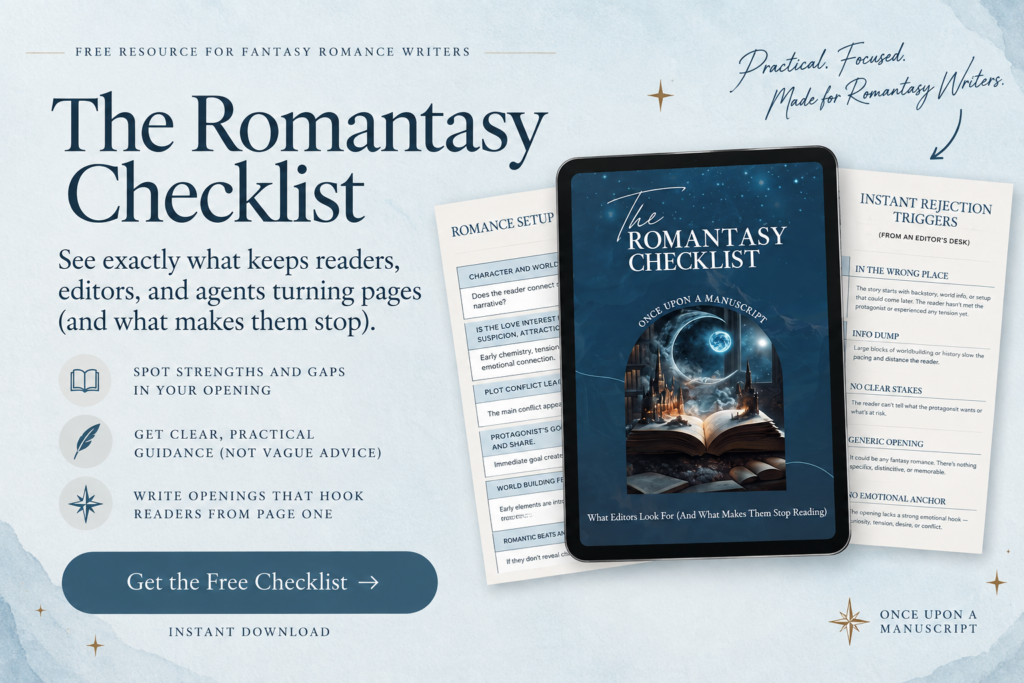
The Romantasy Checklist helps you look at your first 5–10 pages with a colder reader’s eye, so you can spot gaps in character investment, clarity, tension, and momentum before you start rewriting from memory.
Get the free Romantasy Checklist ↓
Boredom is data
Where you skim your own book is where your reader closes it. You wrote those pages; you have every reason on earth to find them interesting, and you still slid past them. Sit with that.
The reader pass tells you where the body is. The editor pass tells you what killed it. And the patterns are usually louder than you expect once you’re looking at marks instead of memories. Marks clustered through chapters nine to thirteen: your middle sags because your protagonist stopped wanting anything specific and started reacting to weather. Marks at the top of nearly every scene: you’re starting scenes too early, three paragraphs before the interesting thing, because you needed the runway while drafting and never took it back out. Marks around one POV character: that character has a job in the plot but no desires of their own. Marks in the exact chapters you’re proudest of: your gorgeous prose is doing something other than carrying your story.
If you’re an observant reader, you may have noticed that this isn’t just an editing process. It is. It’s mine. First pass as a reader, because if I open a manuscript in editor mode, I will spend that pass admiring your syntax and miss the fact that I stopped caring on page ninety. Second pass as an editor explains what the first pass felt. Attention is a finite resource, and you cannot spend it on sentences and structure simultaneously—which is exactly why you need two passes too, just with a longer gap in between.
What a stranger actually is
Here’s the ceiling, and I’d rather you hear it from me. Time and format and role-splitting will get you a long way toward reading your own draft cold. They will not get you all the way, because you can never un-know your book. You will always be the one person on earth who cannot read it for the first time.
That’s the entire job description of a developmental editor. Not a grammarian. Not a person with opinions about your semicolons. A stranger with a craft vocabulary—someone whose only access to your story is the version you actually put on the page, who reads it the way a reader would and then can tell you, in mechanism, why chapter eleven let them go. The FairyGod Reader exists because the first read is the one you can’t perform anymore. It’s already been spent.
So before you open that file and start hunting commas again: put the pen down. You have spent six months rereading a memory with a manuscript stapled to it, nodding along at scenes that exist mostly in your own head, and calling it revision. Go be a stranger for one pass. Find out what’s actually in the room.