
How to Write Dual Timelines Without Losing Your Reader
8/05/26
A dual timeline is one of the most powerful structures in fiction. It is also where a startling number of otherwise strong manuscripts fall apart—quietly, chapter by chapter, in a way the author usually can’t see because you know both timelines equally well and love them equally much. Your reader does not. Your reader has a favorite. What the reader does with their favorite determines the entire fate of the book.
Week two of the Writer’s Workshop, and we’re moving from character to architecture. Last week we took apart the morally gray protagonist; this week we’re looking at the structure they often live inside, because complexity of character and complexity of structure tend to arrive in the same manuscripts. Fair warning: structure is where good intentions help you least. A dual timeline either works or it doesn’t, and the difference is almost never the prose.
What a Dual Timeline Actually Is (And When You Should Use One)
Two narrative threads, set in different time periods, both pulling real narrative weight. Most commonly it’s then and now—past events and their present-day consequences—but the shape varies: the same protagonist at different points in her life, a mother and daughter across eras, two timelines converging on the same event from opposite sides, one timeline holding the mystery the other is trying to solve.
What it is not: a flashback, which is brief, contained, and returns to the present; parallel POVs in the same time period; a framing device. Those are different tools, and calling a flashback habit a dual timeline is how a lot of structural trouble starts.
So when do you actually use one? When the past is as dramatically rich as the present—not background, not context, but active story. When the mystery of what happened is the engine driving the present forward. When the contrast between the two eras is itself the point the book is making. When a single timeline would require flashbacks so large they’d break the pacing anyway.
And when do you not? When one timeline is clearly less interesting than the other, when the past exists only to explain the present, or when the structure is there because it feels sophisticated rather than because it serves the story. There is an honest test, and I’d ask it of any manuscript that crossed my desk: if you removed one timeline entirely, would the story collapse? If yes, the structure is earning its place. If not, you don’t have a dual timeline. You have a novel and its appendix.
The Golden Rule: Both Timelines Must Be Equally Compelling
This is where most dual timelines fail, and they fail here in conception, not execution. One timeline is urgent, gripping, and alive—usually the one the author was excited about when they started. The other is thinner. Expository. Something to get through.
Readers respond to this imbalance with ruthless efficiency: they race through the weaker timeline to get back to the stronger one, then they start skimming it, and then, somewhere around the midpoint, they put the book down—often without being able to tell you why. The why is that half the book had become homework.
Each timeline needs its own complete dramatic arc. Not one arc split across two threads—two arcs in genuine tension with each other, each with stakes specific to its own era, characters actively wanting things, and enough forward momentum that the reader is a little reluctant to leave either one. Here’s the diagnostic I use, and it works on every dual timeline I’ve ever edited: does each chapter end with enough tension that the reader would keep going even if the next chapter didn’t switch? If the answer is no, the weaker timeline needs structural work. Not polish. Structure.
Structuring the Weave
There are four basic patterns, and the right one is dictated by your story, not your preference.
Strict alternation—present, past, present, past—gives readers a predictable rhythm to settle into and works best when the timelines are genuinely balanced. The risk is that it turns mechanical, and readers always know exactly when they’ll get their favorite thread back.
Unequal alternation weights one timeline as primary, with the other surfacing less often; it’s useful, but it has to feel intentional, because imbalance that reads as accident is just a broken structure.
Convergence starts the timelines far apart and interweaves them progressively as they approach a shared event—extremely satisfying when it lands because it builds a natural ticking clock into the book’s spine.
Free weaving follows no pattern at all, just editorial judgment on every switch. It’s the most flexible and by a wide margin the hardest to execute.
What determines the choice is the emotional logic of what information your reader needs and when they need it. Not variety. Not aesthetics. Information, and the order it should land in.
Keeping Readers Oriented
Disoriented readers disengage. This isn’t a stylistic preference; it’s how attention works, and no amount of beautiful prose survives a reader who has to stop and do detective work about when they are.
The tools are unglamorous and non-negotiable. Clear chapter markers—a date, a year, “Seven Years Earlier”—plus the character’s name if POV shifts across timelines, in one consistent format used the whole way through. Voice differentiation, because different timelines carry different emotional registers: if it’s the same character at two ages, her voice has to reflect what she knows and what hasn’t happened to her yet; if it’s two characters, distinct voices aren’t optional. And sensory anchoring—the first line of every new section should plant the reader in time and place before anything else happens.
The standard I hold manuscripts to is the five-line rule. A reader should know exactly when and where they are within five lines of any timeline switch. If it’s taking longer, the chapter opening needs to change. Don’t make them deduce it. Tell them, then immerse them.
If your story is asking readers to track two timelines, your opening pages have to make the structure feel intentional from the start.
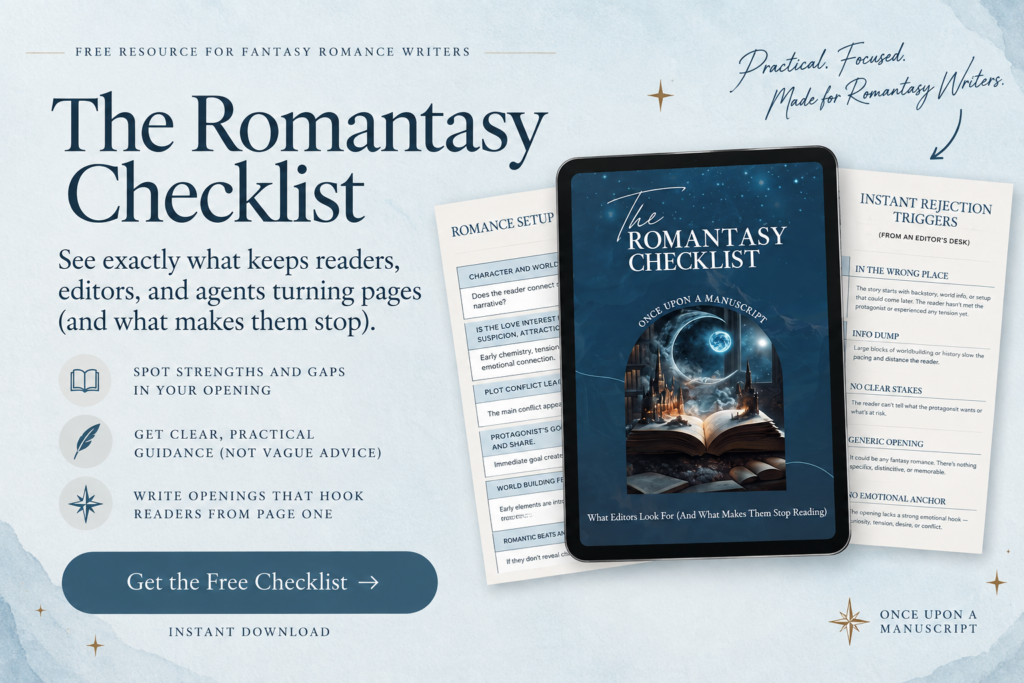
The Romantasy Checklist helps you evaluate whether your first 5–10 pages are giving readers enough clarity, character investment, tension, and momentum to keep following the story without getting lost.
Get the free Romantasy Checklist ↓
How the Timelines Talk to Each Other
Here is the thing that separates a true dual timeline from two novellas sharing a spine: the relationship between the timelines is the architecture of meaning. Everything else is execution.
The interplay can take several shapes. Ironic contrast—the past shows the hope, the present shows what it became. Mystery and revelation—the past holds the answer the present doesn’t yet understand. Thematic echo—the same situation, different characters, different choices, and the comparison is the point. Countdown—past events building toward the catastrophe the present is already living in. Romantasy uses that last one beautifully: the falling-in-love in one thread, the wreckage or the reunion in the other, each scene made heavier by what the reader knows from across the divide.
Whatever the shape, every single switch should hand the reader something—a recontextualization of what they just read, an answered question, a new one, an emotional pivot. “And now we go back in time” is not a reason to switch. And when you do switch, switch at tension. Never at resolution. Leaving one thread at its most charged moment and cutting to the other prolongs that tension productively—the two timelines effectively holding each other’s cliffhangers—but the line between productive prolonging and reader abuse is pacing, so don’t lean on it every chapter.
The Questions a Developmental Editor Asks
When a dual timeline isn’t working, these are the questions I ask it. Does each timeline have a complete emotional arc? Could either sustain a story alone? Does every switch feel purposeful? Is the reader oriented within five lines, every time? Does the interplay create meaning that neither timeline could carry by itself?
If the answer to any of these is no, the structure needs rethinking. Polish won’t fix it—and this is precisely why timeline problems can’t be diagnosed from an opening chapter. The weave only reveals itself across the whole book, which is what a FairyGod Reader edit exists for: reading the full manuscript the way your reader will, tracking both threads at once, and marking the exact chapter where one of them stops pulling its weight.
Take This Back to Your Manuscript
One exercise, and it’s a revealing one. Write the same emotional beat—a moment of betrayal—in both of your timelines. Place them back-to-back as consecutive chapters. Then read them cold. Does the contrast create meaning? Does the reader gain something from living through both?
If yes, your timelines are in genuine conversation, and that conversation is the book. If no, they’re merely coexisting—two stories standing in the same room, politely ignoring each other. Your reader came to eavesdrop on a conversation across time. Make sure that when the past and the present finally speak to each other, they’ve been given a reason to have listened to both.