
Draft Eleven of Chapter One Isn’t Revision—It’s Hiding
9/23/26
There’s a version of revision that looks exactly like work and functions as a hiding place, and you can spot it by one thing: you keep going back to the same pages.
Chapter one, mostly. You’ve rewritten the opening line so many times you’ve cycled back to a phrasing you’d already rejected in June. You’ve moved the paragraph about her mother up, then down, then up. The book behind it hasn’t changed in months. And every time you sit down with that chapter, you feel productive, because you are doing something—you’re just doing it in the one room of the house where nothing structural can go wrong anymore.
This is the last week of the month, which means you’ve done the hard parts. You read the draft cold. You named what was actually wrong instead of calling it boring. You cut the chapter you loved and put it somewhere safe. Now we’re at the spinning: the sentence-level pass, the fun one, the part that actually feels like writing. So let’s talk about what it is, and then let’s talk about when to put it down, because that second question is where more manuscripts die than any structural problem I’ve ever seen.
What line revision actually is
Not “making it prettier.” Three things, mostly.
Rhythm. Sentence length is meaning, not decoration. A paragraph of medium-length sentences reads like a person telling you about their day; the same content, built as three long winding clauses that resolve into something short, hits like a door closing. Read your pages out loud—actually out loud, in a room, mortifying—and mark where you run out of breath, where you stumble, where your voice goes flat because you’ve hit six sentences in a row with the same shape. Your ear knows things your eye will let slide. This is also where you find the paragraph that’s technically fine and rhythmically dead, and the only fix is to break one sentence in half and let the second half land alone.
Filter words. You know this one. She felt her heart race, she saw the door open, she heard him laugh, she noticed the blood, she realized what it meant. Every one of those puts a pane of glass between the reader and the moment—you’re narrating your own security camera footage, technically accurate and deeply unnecessary. Cut the verb and let the thing happen: her heart raced, the door opened, he laughed. The exception is real but narrower than people want it to be. When the POV distance is deliberate—she’s dissociating, she’s refusing to look at what she’s seeing, the noticing is itself the event—a filter word does work. If you can’t say which of those is happening in the sentence, it isn’t the exception.
Precision of image. One exact image beats three approximate ones, and this is where most fantasy and romantasy prose bloats. You’ve written a vaguely ominous, ancient-looking stone corridor lit by flickering torchlight when what you needed was one detail so specific the reader builds the rest for free: the wax has run down the wall in layers, like something has been dripping there for a century. Adjective stacks are what you write when you can’t see the room yet. Go find the noun that already contains the adjective. Sprinted is not ran quickly. The specific thing is almost always shorter than the vague thing, which is why this pass tends to take words out.
The difference between different and different-flavored
Here’s the test, and I want you to be brutal with yourself about it.
A real line edit changes what the reader experiences. After the change, they understand something sooner, feel something harder, see the room instead of a description of a room. You can say what the change did, in a sentence, without using the word “better.”
A different-flavored edit swaps one workable phrasing for another workable phrasing. Wrenched for pulled. Moving the clause to the front. Cutting a sentence you’ll reinstate on Thursday. Nothing about the reader’s experience moves; the paint is a slightly different shade of the same color, and you get the small clean hit of having done something to your book.
The tell is repetition. If you have changed the same sentence back to a previous version even once, that sentence is finished and you are not. That’s not a craft problem anymore. That’s you keeping your hands on the manuscript because putting them down means the next step is other people.
And I’d rather say that plainly than let you find it out in your fourth year with the same chapter one: polishing feels safe because it’s the last stage where the book belongs entirely to you. Nobody has rejected it yet. Nobody has failed to respond to the query, or asked for a full and then gone quiet, or read the opening pages and set it down. As long as you’re revising, the book is still a thing you’re making instead of a thing that can be turned down. That’s not weakness. It’s the most reasonable fear in this entire process, and it’s still keeping your book in a drawer.
Done drafting and afraid to send it are two different conditions. They just wear the same cardigan.
So how do you know
You’re finished with a pass when the changes stop being structural, then stop being scene-level, then start being lateral—synonyms, clause order, a comma you’ve moved twice. You’re finished with revision when you can answer the real questions, and the only ones left are taste.
Can you say what your protagonist wants, and what stands in the way, in one sentence each? Does every scene change something? Did you cut what wasn’t earning its place, rather than negotiating with it? If those are answered and the marks from your cold read are gone, the book is done being revised by you. Not perfect. Done. Those aren’t synonyms, and you’re not going to get the first one—there is no draft where you open it a year later and find nothing you’d change. The goal was never a manuscript you can’t improve. It’s a manuscript where the improvements left are smaller than the cost of not sending it.
If you’ve revised your opening so many times you can’t tell whether you’re improving it or just changing it, stop rewriting long enough to diagnose what’s actually on the page.
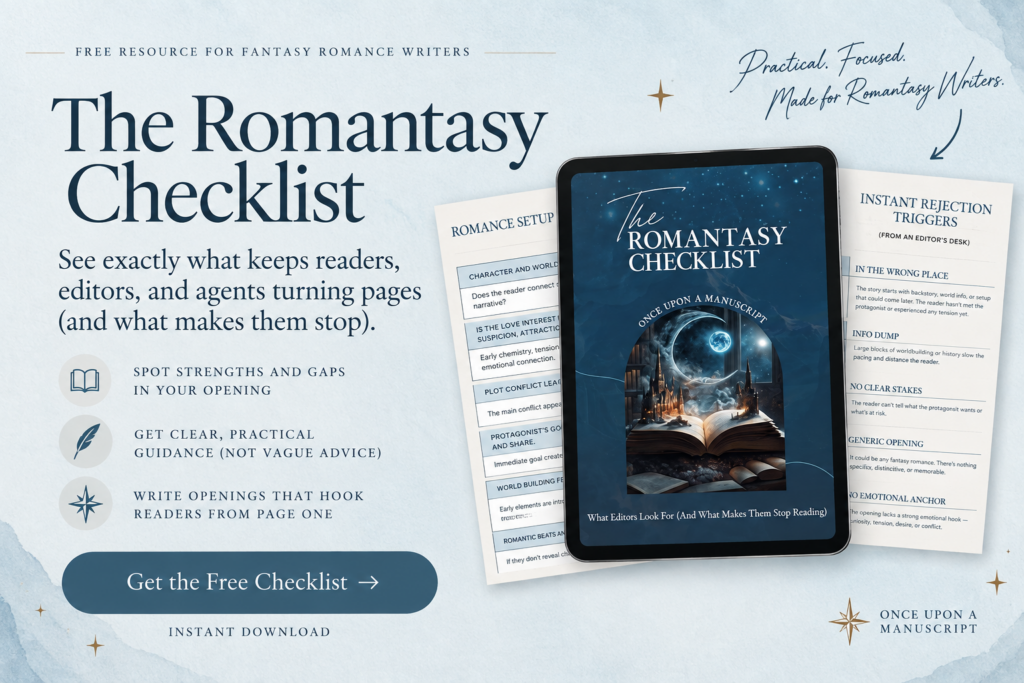
The Romantasy Checklist helps you evaluate your first 5–10 pages for character investment, clarity, tension, pacing, worldbuilding, and genre promise—so you can see whether the opening is doing its job before you put it through draft twelve.
Get the free Romantasy Checklist ↓
Which brings us to your opening pages
They’re the natural place to test all of this, and the worst place to trust yourself.
Your first pages are the most revised, most reread, most anxiously scrutinized part of any manuscript, which means they’re the pages where the cold-read distance from week one is flatly impossible to manufacture. You cannot become a stranger to a chapter you’ve read four hundred times. You’ve long since stopped seeing what’s there and started confirming what you remember approving. Meanwhile, they’re the pages carrying the most weight—an agent, a contest reader, a browser in a bookshop all decide startlingly fast, and they decide on exactly the things this month has been about: whether anything is happening to anyone, whether the prose is doing work or performing, whether they’re in the room or being told about the room.
That’s what the Mini Manuscript Critique is for. Someone who has never seen your book reads your opening pages, tells you what actually lands and where their attention slipped, and gives you the reasons in craft terms you can act on—not a vote of confidence, a diagnosis of the pages that decide whether anyone reads page ten. If you’ve spent this month cutting and restructuring, and you genuinely can’t tell anymore whether your new opening works, that’s not indecision. That’s the correct limit of self-editing, and it has a fix.
The Room is Full of Gold
Here’s the thing about that story nobody dwells on: the spinning ends. She doesn’t stay in the room admiring the work. The gold has to be seen by someone who didn’t make it, or it’s just a very impressive night nobody knows about.
You’ve spent a month looking at your straw honestly, naming the real problem, and paying what the cut cost you. If your pages have gotten as far as taste, you’re done. Open the door.
And when you do—when the structure holds and the sentences work and the book is finally solid enough to interrogate properly—we start asking harder questions next month. Beginning with your villain, and whether he’s actually doing anything in this book or just standing in doorways being ominous about it.