The Scariest Person in Your Book Should Worry You
10/23/26
We’ve spent this month asking what your villain wants, what breaks him, and who he’d spare. Last question, and it’s the one that actually decides whether your book is about something: what does he have in common with her.
Not with the world. With her. Your protagonist. If you can’t answer that in one sentence, you don’t have a theme. You have a fistfight with good lighting.
The mirror test
The best antagonists aren’t opposites. They’re the same want wearing a different justification, or the same person down a different fork in the road. He wants what she wants—the throne, the power, the person, the version of safety that requires someone else to lose. Or he’s what she could become if she made one more compromise than she’s currently willing to make, which means every scene he’s in is secretly a scene about her, whether either of them knows it yet.
Run the test: write one sentence describing what your villain wants, and one sentence describing what your protagonist wants, and look at where they overlap. If the honest answer is “nothing, they just happen to be on opposite sides,” your conflict has no floor under it. It’ll still generate plot—chases, fights, a climax with stakes on paper—but it won’t generate meaning, because meaning requires the two of them to be arguing about the same thing. Take the wall down between them, even partway, and readers feel the difference immediately, even when they can’t articulate why. That’s theme doing its job without announcing itself.
This is also why the strongest villains tend to make the same choice the hero refuses to make, at the same fork, for reasons that almost track. He wanted control, because he’d been powerless once. So has she. He decided that never again was worth any cost. She hasn’t decided that yet—which means the whole book is a long argument about whether she will, and he’s not an obstacle in that argument, he’s the answer she’s trying not to become. Take him out, and the protagonist’s arc has nothing to measure itself against.
If your villain is supposed to reflect something your protagonist could become, make sure the connection is doing more than creating a clever parallel.
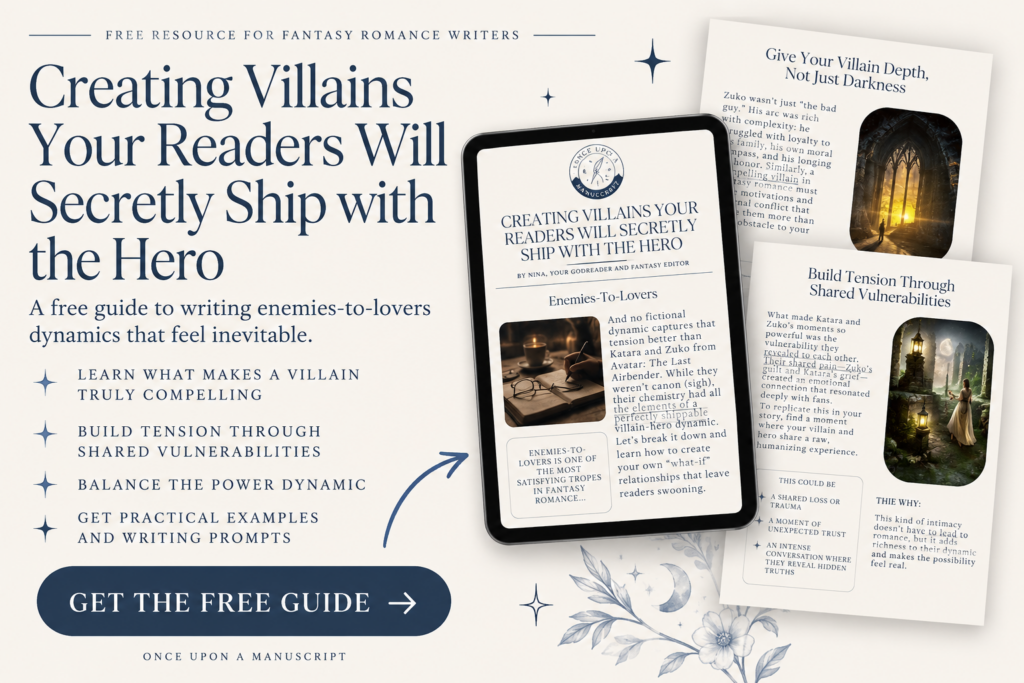
Creating Villains Your Readers Will Secretly Ship With the Hero will help you build the motivation, vulnerability, mirrored desires, and power tension that make an antagonist feel personally connected to the hero—not just positioned against them.
Get the free Villains Guide ↓
Now flip it
Here’s the part that’s actually going to sit wrong, and it should. If your villain is a version of your protagonist down a different fork, run the same question in reverse: what has she done that the book has quietly decided not to notice.
Point-of-view is a form of custody. Whoever narrates gets the benefit of the doubt, automatically, permanently, and most stories spend that trust without ever examining it. The protagonist lies to someone who trusted her, and the narration calls it strategy. She abandons someone who needed her, and the narration calls it growth. She does something genuinely cruel to a character the reader has been trained not to like, and the book never asks her to sit with it, because we’re in her head and her head has already moved on. Nobody in the story holds her accountable, because the person who’d have to hold her accountable is the same person telling you the story.
That’s not a flaw to fix. It might be the most interesting thing in your story, if you let yourself see it instead of protecting her from it. The scariest person in a lot of books isn’t the one with the body count on the page—it’s the one the narrative has quietly agreed to forgive faster than the facts deserve, simply because she’s the one holding the pen. Ask yourself honestly what would happen if a side character narrated your protagonist’s worst scene. Would it still read as strategy. Would it still read as growth. If the answer changes depending on whose head we’re in, you haven’t written an unreliable narrator by accident—you’ve written a hero with better PR than her actions have earned, and readers can feel that too, even when they can’t name it.
Whose story it is
There’s an old woman in the woods who feeds hungry children. That’s the whole biography, stripped of the version we all know: a woman, alone, in a house, who takes in two starving kids and gives them food. The story calls her a monster because of whose account we’re reading—a child who got scared, who saw an old woman living strangely and alone and decided that was evidence of evil, in a tale told by people who needed a reason it was fine to push her into her own oven and take her house. She was never actually dangerous in the version that survives. She was inconvenient to a narrative that needed a monster, so the story made her one.
That’s not a twist. It’s the quiet truth under every fairy tale villain, and under most of the ones you’ll ever write: who your book decides is the monster is an authorial choice, not a fact about the character, and readers can feel the difference between a villain the story earned and a villain the story simply needed. Every choice you’ve made this month—what he wants, what breaks him, who he spares—has also been a choice about whose story this is. That’s worth sitting with before you call it finished.
Where this actually breaks
This is the most structural question in the whole month, because theme isn’t a line you can insert in revision—it’s the accumulated effect of every choice about who wants what, who gets narrated with sympathy, and who gets narrated as a threat. You can’t patch it with a better villain monologue any more than you could patch the villain’s function with a better entrance back in week one. It has to be traced across the entire story: does the mirror actually hold from the first act to the last, does the protagonist’s sympathy stay earned or does the narration start doing favors for her around the midpoint, does the ending ask her to actually reckon with the version of her the villain represented, or does it let her win without the argument ever really landing. That’s exactly the kind of thread a full FairyGod Reader edit exists to pull—not “is the villain interesting,” but “is your book actually about the thing it thinks it’s about,” because that’s the difference between a manuscript that resolves and a story that means something.
Spooky season’s almost over. Drafting season isn’t—you’re about to go back into the woods and write a whole new book, which means a whole new cast of people who want things, and a whole new decision about who your story is going to call the monster. Before you start, it’s worth knowing who’s actually waiting for you in there. Sometimes it’s a wolf. Sometimes it’s a woman with a house made of gingerbread. And sometimes, uncomfortably, it’s just your protagonist, looked at by someone who isn’t in love with her yet.